
2025 was a Bond year of small news and big changes. With the February 2025 news that EON Productions, Barbara Broccoli and Michael G. Wilson would be sharing ownership of the James Bond brand with Amazon MGM Studios but not creative control moving forward, the Bond, movie and entertainment world wondered if was both a thunderball and a wrecking ball moment for the franchise.
Yet, as those gunbarrel white dots prove, the circle of life is a curious one and whilst the bullets are being readied to take the Bond project forward over the next year (including a big new thing from this bullet catcher, Mark O’Connell), 2025 nevertheless saw some Bond alumni exit stage left…
‘Always be original. Never duplicate what you’ve seen another actor do. Be true to the character that you’ve been given, and the rest will come easy.’
- Lee Tamahori
It was Once Were Warriors (1994) that sparked the attention of producer Barbara Broccoli. Its director Lee Tamahori created a jagged domestic drama on a national scale and was the first indie director crafting real local stories who was invited to helm Pierce Brosnan’s fourth and final Bond bullet, Die Another Day (2002). It marked the fortieth anniversary of the 007 franchise and was a wilful, camp, future minded and global caper on a scale maybe the character and series needed a year after 9/11.

Tamahori captained a totally fun Bond adventure that signed off Pierce Brosnan, nabbed some royal favours and monarchal endorsements, was furnished with the biggest pop and actor names of the day and created a somewhat immortal ice surfing scene that is nothing but happily ridiculous – like Die Another Day itself. He also directed a film that sealed the deal and momentum for the next phase of James Bond’s timeline. We would not have seen Casino Royale (2006) or arguably Daniel Craig had Tamahori’s bullet not done so well at the global box-office.
‘If at first you don’t succeed, Mr. Kidd…’
- Diamonds are Forever / 1971
Fifty-four years since 1971’s Diamonds are Forever there has still to be another major franchise feature film to showcase a faggy, queer and contained couple who are not only besotted with each other until the last frame, but who defend each other until the death. Enter Putter Smith and Bruce Glover as Mr. Kidd and Mr. Wint.

Both actors were straight. Yet, with screenwriter Tom Mankiewicz’s skills and a sadistic, kinky tone like no other Bond film, both actors delivered a pair of homo-cidal killers who were wholly queer-realistic, waspish, deliciously barbed, full of shade and menace, and on point at every turn.
Bruce Glover adored his craft. A character actor who wrote the character actor book and continued working and tutoring, he was a renaissance man, into what he loved and always delivered. One of my best birthday wishes once came from Mr. Wint himself. Queer representation in mainstream matinee cinema owes him a great debt. One is never too old to learn from a master.

It was Bond production designer Peter Lamont who once kindly and enthusiastically corrected me in-front of the lady herself at Pinewood once regarding her cinematic legacy. He said ‘Elaine is not just the continuity girl, she is THE continuity girl!’.
Elaine Schreyeck was what the old studio belt of the Home Counties used to call a ‘continuity girl’. Script supervisor and a vital set of ears, eyes and detail, Elaine was over one hundred years old and was an industry legend. Hers was not just a role about timings, lines and details. Hers was one of personalities, enabling a take, quality control and a careful navigating of egos, stresses and call sheets.
From the glory days of Ealing Studios, being a secretary to Basil Dearden, Pinewood Studios, Laurence Olivier, Paramount Studios, Superman The Movie, Evil Under The Sun, Sleuth, Battle of Britain, Labyrinth, The Omen, Dead of Night, The Mirror Crack’d, Suddenly Last Summer, The Prince and The Showgirl and six Bond movies (Diamonds are Forever, Live and Let Die, The Man with the Golden Gun, Moonraker, For Your Eyes Only and Octopussy), Elaine’s history is THE history of British film studio production. And the wake of respect followed her across many decades and generations. She was also a great, eloquent matriarch of the studios, a perfect wrangler of memories, anecdotes and personalities and all conducted with an old school gravitas and poise.
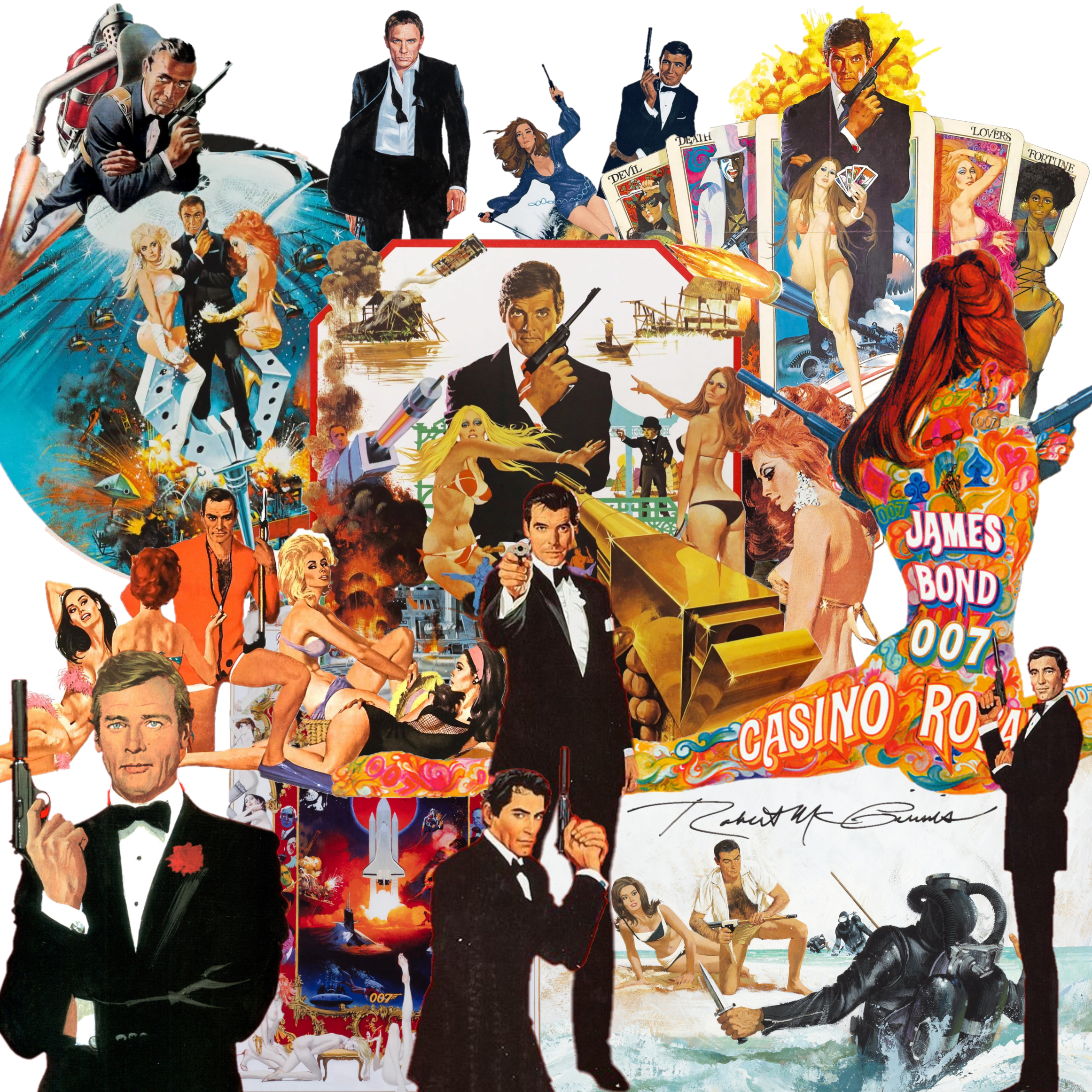
Jet Pack art / Frank McCarthy
“You know, the only person that doesn’t believe Bob is a genius is Bob.”
- Don Smolen, publicity director, United Artists
He was not the first and many continue to sketch in his wake, but the artist and illustrator Robert McGinnis was to Bond poster design what John Barry was to the score, Peter Hunt was to editing and Ken Adam was to the production. The McGinnis Woman was a languid, sexual, glamourous, dangerous and current glory of cinema poster design. The McGinnis Bond was a tuxedoed pillar of guns, folded arms and tailored stardom.
A former Disney artist, McGinnis edged into paperback design and eventually lobby art. His Bond film work in the 1960s and 1970s – and his returning forays to cover the later 007s for later commissions – remains the graphical benchmark of Bond.
Robert McGinnis is a vital genome of the design DNA of James Bond onscreen and beyond. Slender frames, dripping costuming, and that tapered sexuality sold Bond across the world. Live and Let Die, Thunderball, The Man with the Golden Gun, You Only Live Twice, Casino Royale, Diamonds are Forever and On Her Majesty’s Secret Service were globally dressed with Robert McGinnis pulp fiction eye and consumer-steered elegance.
Breakfast at Tiffany’s, Arabesque, Barbarella, Cactus Flower, The Incredibles, The Odd Couple and How To Steal a Million are all blessed by movie theatres’ very own Norman Rockwell – and a man whose artistic influence reaches across all levels of pop-culture, costuming, advertising, retail commerce, fashions, and mid-century interior design.

‘The British don’t have a lot of flashy special effects, nor do they pay a lot, but they sure make up for it in the time and care they put into their projects.’
- Joe Don Baker
The deliberate voice of America across three Bond films, Joe Don Baker played both villain and ally. His Napoleonic spin as villain Brad Whitaker in The Living Daylights (1987) was an ever prescient swipe at Oliver North and Reagan’s Soviet activities in the 1980s. His later role as brash ally Jack Wade in GoldenEye (1995) and Tomorrow Never Dies (1997) brought both Felix Leiter and Sheriff J W Pepper back in spirit into the Bond fold and the Brosnan era.
Other sad losses from the Bond world in 2025 include original ‘007’ logo artist and renowned illustrator Joe Caroff, actress Samantha Eggar (‘M’ in the computer games 007 – Nightfire and Everything or Nothing), actor Cary-Hiroyuki Tagawa (Licence to Kill, 1989), actor Micheal Madsen (Die Another Day, 2002), actor Jules Walter (Live and Let Die, A View to a Kill), fashion designer Giorgio Armani who dressed Bond onscreen and on the red carpet, actor Tchéky Karyo (GoldenEye, 1995), stunt artist Carl Ciarfalio (Licence to Kill, 1989), production designer Stuart Craig (Casino Royale, 1967), actress and writer Jean Marsh (Casino Royale, 1967), stunt artist Ronnie Rondell Jr. (Diamonds are Forever, 1971), lyricist Alan Bergman (Never Say Never Again, 1983), art director Les Dilley (From Russia with Love, Never Say Never Again), actor Emilio Echevarría (Die Another Day, 2002), and stunt artist Tony Van Silva (Skyfall, 2012).


